Calming the storm or turbulance ahead?
Alun Oliver comments on the recent Supreme Court decision in Ørsted West of Duddon Sands (UK) Ltd (now Ørsted Schroders Greencoat WODS Holdco Limited) and others v CRC.

ORIGINALLY PUBLISHED IN TAXATION - 23 APRIL 2026. DOWNLOAD ARTICLE IN RIGHT COLUMN.
The Supreme Court’s decision in Ørsted West of Duddon Sands (UK) Ltd (now Ørsted Schroders Greencoat WODS Holdco Limited) and others v CRC [2026] UKSC 12 has unanimously allowed HMRC’s appeal to overturn the previous Court of Appeal (CoA) decision [2025] STC 563 published in February 2025. This is further to earlier decisions from the Upper Tribunal (UT) and First-tier Tribunal (FTT) when it was initially known as Gunfleet Sands. This case focuses on four special purpose vehicle (SPV) entities that built and operate these windfarms, hereinafter ‘Ørsted’.
After just ten weeks from the hearing in the Supreme Court, Lady Rose set out her decision – with which Lord Lloyd-Jones, Lord Hamblen, Lord Burrows and Lord Richards all agreed – concluding this long running capital allowances case. This case is not just relevant to tax geeks and windfarms but potentially impacts all large capital projects involving construction and pre-development expenditure – particularly large infrastructure or energy sector projects.
Ørsted is seen by many as an essential case, seeking to clarify the long-standing debate on the eligibility of ‘design fees’, informally progressed by HMRC for many years under the ‘Newstead formula’, which had factored in a disallowance of certain project fees – on account of their remoteness from the specific eligible assets. Yet in this decision at para 95, Lady Rose states that ‘Ms Wilson made clear that HMRC wished to reserve their position on whether the cost of producing the final technical drawings and specifications which are then “made real” by the manufacturer could be recoverable’, seeking to distinguish between fabrication and construction and the more remote studies and surveys that informed that design.
Lady Rose stated the respondent’s argument of what is ‘design’ and thus within the ‘provision on plant and machinery’ to be ‘much too broad’, saying that: ‘To maintain, as Ørsted does, that the cost of a survey which shows that there is no unexploded ordnance on the seabed at the proposed site is just as much qualifying expenditure as that spent on a survey that discloses something that prompts the developer to reconfigure the placement of the turbines shows how broad the test they propose would be.’ This seems counter intuitive as few, if any, taxpayers would spend money on reports and studies unless they were important and necessary. Is the consequential impact on the design and what is ultimately built now the determining feature of eligibility?
Careful analysis of project costs and clear linkage between specific costs and the assets created will be needed to successfully underpin the capital allowances claim, here plant and machinery allowances (PMAs). We may see a renewed scrutiny by HMRC on project design fees, as it seeks to use this decision in reducing the cost of these valuable tax incentives to an exchequer under clear fiscal pressure. Thankfully, Lady Rose confirmed at para 58 that HMRC had no issue with ‘preliminaries’ and accepted the FTT position (at paras 205–211) to be correct.
Background
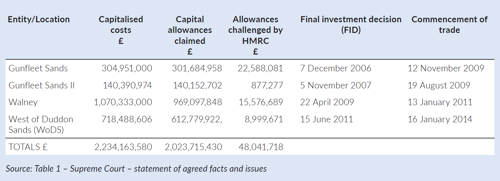
The litigation stems back in November 2021 and the FTT, where HMRC sought to challenge significant costs relating to pre-construction development expenditure that Ørsted had claimed at various locations off the UK coast – further to their leasing areas of the seabed from the Crown Estate in 2000 and 2003 and assets brought on stream between 2009 and 2014 at a combined cost in excess of £2.23bn.
The whole case turns on the Capital Allowances Act 2001 (CAA 2001), s 11(4), which determines whether or not expenditure is qualifying expenditure, and so benefiting from tax relief, if ‘it is capital expenditure on the provision of plant or machinery wholly or partly for the purposes of the qualifying activity carried on by the person incurring the expenditure’.
Elizabeth Wilson KC (Pump Court Tax Chambers) made her ultimately successful arguments on behalf of appellants, HMRC, to the panel of five justices. Michael Jones KC (Gray’s Inn Tax Chambers), represented the respondents, Ørsted. In total, some seven hours of verbal evidence was presented – all available via the Supreme Court’s website and recorded sessions – in addition to various document bundles containing each party’s written case and the statement of agreed facts and issues.
Ørsted used separate SPVs to develop and, following a decision (the final investment decision, or FID), construct the windfarms. Each Ørsted company commenced generating electricity (and thereby commenced trading) on the dates set out in the table above. The relevant accounting periods, costs and disputed adjustments that underpin this case are also noted.
The table shows figures derived from the FTT evidence – although this decision was concerned with the principle of eligibility and not with quantum – that will now enable the parties to finalise the companies’ respective tax computations and allowances claims.
HMRC had challenged and made amendments to the relevant tax computations as it felt that some of the expenditures incurred on various studies (environmental impact, metocean, geophysical and geotechnical studies) used to inform the design and development of windfarms, did not fall within the scope of ‘qualifying expenditure’ for the purposes of the CAA 2001. Some changes to the quantum had occurred between the FTT and CoA, such that Ørsted had not progressed all elements of their original case, reducing the contested sum before the Supreme Court to approximately £42m.
The anatomy of a windfarm
Between 2000 and 2003, Ørsted had successfully obtained licences to develop the various offshore windfarms. Each consisted of a collection or ‘array’ of wind turbine generators (wind turbines) that are usually largely identical and are connected electrically by cables and then further connected via substations to the public grid. The number of wind turbines on these windfarms is as follows: Gunfleet, off the coast of Essex, comprises 30 and 18 wind turbines in phase 1 and 2, respectively; Walney, off the coast of Cumbria, is made up of 102 turbines; and West of Duddon Sands in the Irish Sea comprises 108 turbines.
After securing the licence to develop the windfarms, an extensive range of studies were undertaken to establish the viability of the sites and inform the design of the windfarms. A key element is the environmental impact assessment (EIA) that in turn required other studies. The primary step is a ‘scoping document’ that highlights the broad principles to be covered and is issued to all the relevant stakeholders, for comment. Such stakeholders might include the Department of Trade and Industry, Department for Environment, Food and Rural Affairs, the Environment Agency, the Ministry of Defence and the relevant local planning authorities.
Further studies, now considered by the government as ‘pre-development expenditure’ and part of a deferred consultation launched further to the Budget announcement by Rachel Reeves MP in October 2024, included:
landscape, seascape and visual assessments;
benthos studies (identifying the impact on benthic organisms living in or on the seabed);
ornithologic and collision risk studies (exploring migration routes that might be impacted);
fish and shellfish studies (to understand which species were in the vicinity of the windfarm and export cable routes, and might be of conservation or commercial interest);
marine mammal studies;
archaeological studies (to determine the number of maritime sites and finds such as known wrecks, reported losses and recorded obstructions within the area of the windfarm);
noise assessment;
telecoms and radar interference studies;
traffic, transport and tourism (to consider aviation and maritime collision risk).
Additionally, the socio-economic and tourism studies that had been held as non-qualifying by the FTT, as these studies ‘did not directly relate to the design of the windfarm or of the wind turbines and had no impact on the construction of the windfarm and installation of the wind turbines’. Ørsted did not appeal this part.
Each turbine’s long blades (between 50–60 metres each) are supported by a tower which, in turn, is connected to a ‘monopile’ foundation by a ‘transition piece’. The monopile is a cylindrical steel tube that is driven or drilled into the seabed. As the FTT noted in paragraph 51 of its decision, the evidence before it was that ‘Each of the monopile foundations in the windfarms in these appeals was physically unique, save for one pair of foundations at Walney which were identical’.
The array cables are highly dependent on the ground and soil conditions. They need to be buried more deeply in soft ground than in hard ground to protect them from exposure and damage, and the routes along which they are laid also have to avoid seabed hazards such as boulders.
So far as the sea conditions are concerned, the magnitude and frequencies of the wind, waves and currents affect the natural frequency of the wind turbine. If the frequencies of these external forces acting on the wind turbine coincide with the wind turbine’s natural frequency, the vibrations within the wind turbine are amplified and this can cause structural fatigue. The towers must therefore be tuned specifically for their discrete site.
These towers are also made from steel plates and the thickness of those plates will depend on how stiff and heavy they need to be to withstand the wind and wave loads (and protect its natural frequency) that are expected to be faced within the designed lifespan.
Arguments of the matter
Mr Jones presented arguments principally drawn from CIR v Barclay, Curle Co Ltd [1969] 45 TC 221; McVeigh v Arthur Sanderson & Sons [1969] 45 TC 273, Ben-Odeco Ltd v Powlson [1978] STC 460 that these studies went beyond ‘general information’ but were integral to the iterative design and construction of these windfarms, previously accepted as each being ‘entirety assets’ – rather than distinct generating, cable arrays, transformer and distribution assets. He illustrated this with the map of West of Dudden Sands in the evidence bundle that showed a large gap in the layout – resulting from bedrock that would not enable the monopile foundations – hence the array layout (its design) was altered because of these studies.
Both parties raised various other precedent case decisions over the duration of the different court and tribunal hearings including, among others: Yarmouth v France [1887] 19 QBD 647; Cole Brothers Ltd v Phillips [1980] STC 518; Attwood (HMIT) v Anduff Car Wash Ltd [1997] STC 1167; JD Wetherspoon plc v CRC [2012] STC 1450, Cheshire Cavity Storage 1 Ltd v CRC [2022] STC 622; Urenco Chemplants Ltd and another v CRC [2023] STC 54; Altrad Services Ltd v CRC [2024] STC 1201.
Noting that Ben-Odeco illustrated that costs can extend beyond the simple purchase price, such that expenditure could include ‘such items as transport and installation’, Newey LJ stated, in the CoA decision, his agreement with the FTT findings that: ‘What is at issue in the present case is not expenditure incurred on the physical process of installing the generation assets, but the costs of studies which are said to have informed how installation should be effected. In my view, such costs can potentially also be said to have been incurred “on the provision of” the generation assets.’ Further that, ‘it appears to me that section 11 encompasses costs of design as well as costs of installation, and that the eligible expenditure will extend to costs of studies which informed such installation or design’.
The CoA noted that the expenditure was made once and for all, with the aim of enhancing the value of the leases, the windfarms and their respective businesses – as lump sum payments with a view to enduring advantages – and therefore capital. Neither party sought to redefine the costs as revenue expenditure.
Ms Wilson successfully argued to disallow these studies, that in her words ‘only provided data and informed the design… but only if you have the plant in your sights’, taking the stance that only costs incurred once the plant in question is determined could be qualifying expenditure.
Supreme Court’s decision
In her decision, Lady Rose stated that ‘Barclay, Curle was also not authority for the proposition that because plant cannot be made without design, the costs of design must qualify’, despite that fact that wider costs may have been allowed beyond the costs allowed in that case on the provision and installation of the asset.
At para 65, Lady Rose further concluded: ‘I do not regard these studies and surveys as close to the boundary between what should be regarded as “on” plant and what is too far away from the plant itself to be so regarded. They do not fall within the statutory wording and I would therefore allow the appeal.’
This effectively overturns the previous CoA decision and deems that prior judgment as overly generous and too broad an interpretation of what constituted qualifying expenditure.
Conclusions
I fear this decision has not solved with any certainty the issue that many expected it might. It has extended the long-held understanding from Ben-Odeco that individual taxpayers should not have different tax positions and that certain expenditures can be ‘too remote’ from the specific eligible asset costs.
As stated by Lord Russell in that 1978 decision, the most precise reasoning for rejecting the company’s case was when he said that ‘the effect of the expenditure was the provision of finance and not the provision of plant’. However, the precise location of the dividing line as to eligible or ineligible design costs is by no means clearer and so will ‘rumble on’, pending a reinstatement of the proposed consultation and any refinement of the legislation.
As Mr Jones argued, albeit unsuccessfully, for tax relief to have the intended outcome – of helping to drive investment by businesses into these major infrastructure schemes – a degree of certainty is essential. Rapid adoption of alternative energy sources and transforming our over-dependence on carbon fuels is essential to improve sustainability and expand our renewables sector, which depends upon these vital and significant investments, as well as across other ‘infrastructure’ projects – whether data centre, defence or transportation.
The new advanced tax certainty proposals, for those taxpayers undertaking large-scale projects (costing £1bn or more) and due to begin in July 2026, whereby HMRC can agree the likely tax position in advance, may not be sufficient to satiate the global operators that have a clear choice as to where they choose to do business.
Some, in light of this decision, may simply choose to invest their resources outside the UK – impacting jobs, growth and prosperity – bearing in mind the reduction in relief for PMAs from 25% a year in 2008 to the current rate of 14% (and carved out of integral feature allowances at 6%) has already significantly slowed the tax savings derived from large scale capital projects.
Next Steps
If you would like to discuss any property tax matters or specific queries relating to the above information, then please do contact the team on 0345 230 6450 or [email protected]. We look forward to speaking with you soon.
ORIGINALLY PUBLISHED IN TAXATION - 23 APRIL 2026. DOWNLOAD ARTICLE IN RIGHT COLUMN.