Response to the Consultation on the proposed London Emergency Housing Package
Community Infrastructure Levy (CIL) - Update By Alun Oliver FRICS

Slow Progress...
ALUN OLIVER FRICS, Managing Director of Property Taxation Specialists, E³ Consulting, comments upon the March publication of the Government’s ‘Response to the Consultation on the proposed London Emergency Housing Package’. The proposals, first released in October 2025 for consultation - sought views on two parts: time limited relief from Borough level Community Infrastructure Levy (CIL) and proposals to make permanent changes to the Mayor of London’s planning powers under the Town and Country Planning (Mayor of London) Order 2008. This article concentrates on the CIL proposals.
The rationale as set out by both the Greater London Authority (GLA) and Ministry of Housing, Communities and Local Government (MHCLG) is that London’s housing starts remain substantially below their long-term annual average of around 18,000 homes a year. The low level of starts we have seen in London in the last three years feed into lower housing completions over the coming years, meaning fewer homes and fewer affordable homes for Londoners.
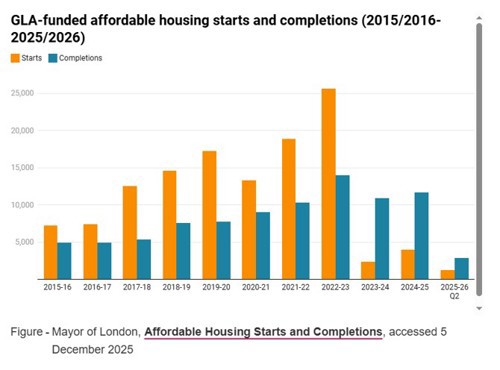
This urgent action is proposed as an ‘Emergency Housing Package’ to attempt to boost housing across the capital.
Background
The consultation highlighted a challenging economic environment – following the inflationary pressures and interest rate increases of recent years that have increased costs and squeezed the profitability of schemes. In London, this has been felt particularly acutely; it was compounded by flagging sales values and an increased exposure to regulatory burdens borne by flatted development due to cladding - the imminent Building Safety Levy from October 2026 won’t help. Combined with the fact that projects have been taken forward with reduced levels of affordable housing; sacrificed to enable schemes striving for viability. Developers which cannot deliver the Fast Track Route level of 35% affordable housing currently need to go down the Viability Tested Route in order to proceed. This has resulted in some schemes being permitted with less than a tenth of the housing they provide being affordable.
To counter this, the CIL proposals are that where developers commit to 20% affordable housing, they would get a 50% CIL reduction on Borough CIL (BCIL) – the element of CIL calculated by the relevant borough and separate to the GLA set Mayoral CIL (MCIL). If the developers increase the affordable housing proportion up to 35% of the scheme, then the CIL reduction would increase to 80% of BCIL. The savings being on a sliding scale between these two extremes – for example, at 25% social housing, the saving would be 60% of BCIL. MCIL is excluded as the receipts from this are ‘ring-fenced’ for large projects and, currently, are dedicated to debt repayment on the Elizabeth Line until the early 2040s.
The Government proposes that the developer provides a signed statutory declaration as to their viability evidence (and that the assumptions used are fair and reasonable) and, thus, is significantly less onerous than the Full Viability Assessment necessitated by the Viability Tested Route. The deadline for eligibility has also been extended – in two ways:
Firstly, that the cut-off date has been pushed back to 31 March 2028 - whereby the project must have a valid application by this date, not the grant of permission date as initial proposed; and
Secondly, the final project commencement date will also be pushed back to 31 March 2030.
Both MHCLG and GLA insist these measures remain a time-limited intervention, and the Government has confirmed its long-term commitment to the CIL regime for the delivery of local infrastructure. The responses from the consultation (drawn from only 217 respondents)[1] stressed that the process for securing this CIL relief must be quick, certain and predictable in order for it to be pursued and achieve its targeted boost to housing starts and, ultimately, completions.
[1] UK Government Response at >>> Consultation on the proposed London Emergency Housing Package: Government response - GOV.UK.
Targeted Proposals
To qualify the projects must have met the eligibility criteria:
Only developments situated within CIL charging authority areas in Greater London will be eligible to apply.
Sites must not be on excluded land (i.e. Green Belt, Metropolitan Open Land (MOL) or land which is a park, recreation ground, allotment, golf course or other locally designated open space) – thus, focusing the relief on ‘brownfield sites’.
Relief will be limited by land use: only residential developments (excluding student and co-living accommodation) will be eligible for the relief.
Limited by the inclusion of a minimum threshold of BCIL liability of £500,000 or more. Before any emergency relief is applied (and after factoring-in any other existing CIL reliefs that might reduce the CIL liability).
The threshold is based on the calculation of CIL liability for the development as a whole, and not individual phases of development.
Must provide at least 20% affordable housing, which can be ‘flexed’ up to a higher threshold of 35% social housing.
All subject to a £25,000 application fee payable to the Local Planning Authority (LPA).
Ominous Silence or Rabbit in the Headlights?
Strangely, there has been little narrative or further reference to these CIL proposals and time keeps ticking on since the publication in March! There were three dominant groups of respondents – individuals, LPAs and developers. The individuals are probably drawn from those impacted by CIL on self-build or very small developers operating as self-employed. As it is otherwise highly unlikely individuals outside of these groups will ever have heard of CIL!
Developers and advisors across the Built Environment recognise that time is money, and so, any scheme must be clear, transparent and efficient to operate and determine the applicant and apply the reduction as applicable. However, LPAs, perhaps unsurprisingly, were more concerned with affordability, accuracy and clawback if circumstances change – i.e. wanting to ensure that if the scheme later amends the affordable housing provision, there is a clawback of the CIL.
Whilst Government has been fighting both local elections (and, more recently, itself), the lack of further confirmation of these measures suggests that all is not agreed, nor straight forward.
Since winning power in July 2024, the Labour Government has introduced significant changes to the planning laws and new policies including grey belt, travel hubs and brownfield passports all aimed at accelerating the housing growth – to date, with little meaningful impact. Yet, these “much needed” emergency measures are moving at a snail’s pace!
We truly hope this is not another case of CIL consultation simply being parked in the ‘long grass’, without any meaningful changes! There was an earlier ‘Technical Consultation on Infrastructure Levy’ that ran between March 2023 and June 2023 – but the responses of that consultation which mooted more far-reaching proposals to change (and replace) CIL were jettisoned by Labour in September 2024 and none of the responses ever published. No doubt due to virtually all commentators at that time stating their distain, even disgust, at the rather radical proposals to replace CIL with a new Infrastructure Levy, that most felt would not, in any way, improve things!
Discretion Required?
At question 18, the consultation asked about giving the LPAs discretion in relation to the relief and, if so, in what circumstances, and how this may work such that robust incentives for additional affordable housing remain. Ironically, over two thirds of LPAs said that they should have discretion, suggesting that this would enable boroughs to better manage their infrastructure delivery and requirements, and allow boroughs to apply the relief proportionately in a way which reflects local infrastructure impacts. Yet, the existing Discretionary Relief for Exceptional Circumstances available under Regulation 55 has not been adopted by many LPAs at all and those that have adopted this discretionary relief, have seldom accepted any claims. In contrast, over 75% of developers that responded expressed concern that any discretion LPAs were given would lead to uncertainty and an inconsistent approach across different areas. A quarter of developers also raised that introducing discretion could lead to delays in processing applications, which could create challenges given the time-limited nature of this ‘emergency relief’.
Even More CIL Consultation Soon!
On 29 April 2026, Housing Minister, Matthew Pennycook MP, announced that the Government intends to run a further consultation on CIL. This separate measure seeks to address the disproportionate impact of ‘minor’ changes that have cost householders and particularly ‘self-builders’ considerable sums across London and the Southeast - where CIL housing rates are typically in the region of £100/m² to £750/m² before any uplift for indexation! The parliamentary debate was organised by Sir Jeremy Hunt, MP For Godalming and Ash, located within Waverley Borough Council area and one of the LPAs in the centre of self-build disquiet. Pennycook also confirmed some action to address those that have been hit by significant CIL charges promising that the Government “it was not the case, when it comes to those already affected by this issue, we intend to do nothing.”
Conclusions
Whilst the extended timescale eases some concerns, making these proposals more likely to benefit marginal or uneconomic schemes, we are still concerned about unintended consequences – principally, that some developers could slow further project commencements and build out, whilst those with potentially eligible schemes pause any activity, in anticipation of the proposals becoming live and thus enabling the 50% to 80% savings against their BCIL component. Once started on site, they are no longer eligible for the relief.
Interestingly, another overdue consultation response is that on the effectiveness of Land Remediation Tax Relief (LRTR) and ran from July to September 2025. The Government sought to explore and improve the tax relief available on the costs of remediating contaminated or long-term derelict land. They wanted to determine whether this incentive was still meeting its objective of boosting regeneration of brownfield land, whilst seeking to improve understanding of how robust the relief is against potential abuse. Particularly, this is relevant in light of the significant tax abuses in the area of Research & Development Tax Relief – where HMRC estimated that the overall level of error and fraud for 2020 to 2021 was £1.13billion - and within the wider context of the Corporate Tax Road Map.
Tax breaks can have a significant impact on property and construction activity – but we seem, currently, to be languishing with indecision, and more and more navel gazing consultations are only helpful if they then lead to clear action that addresses the sector’s needs.
CIL is by no means perfect, but with it being operational since 2012 and an increasing majority of English and Welsh LPAs having now adopted CIL, it can be refined and improved to address its short falls rather than wholescale change. It does contribute to the respective LPA financial needs – being the parks and play areas, schools and GP surgeries or other important infrastructure – but all CIL receipts and the interest that accrues must be ring-fenced for infrastructure and not allowed to cross-subsidise other council requirements.
We consider that one area that could enable a better and more timely resolution of numerous CIL issues, particularly where the economic viability is challenging – would be for the Government to make Reg.55 a mandatory measure (instead of this currently being discretionary) – thus, ensuring it applies in all LPAs that operate CIL. It also needs to modify the criteria (not least to allow schemes without s.106 obligations to benefit) to widen the scope for LPAs to apply some discretion to ‘exceptional’ situations and finally augment these changes with a right of Apply via the Valuation Office or the Planning Inspectorate, thus, ensuring some appropriate third-party oversight to resolve disputes.
Next Steps
If you would like to discuss any property tax matters or specific queries relating to the above information, then please do contact the team on 0345 230 6450 or [email protected]. We look forward to speaking with you soon.